Hardwood Pellets vs. Softwood Pellets
Should you choose hardwood or softwood pellets for your stove? Many homeowners new to pellet heating have this question on …
01.27.2025
4 minute read

Pellet stoves have quietly become one of the most talked-about ways to heat a home, especially as heating oil and propane prices keep homeowners guessing from one winter to the next. But for every homeowner who's ready to make the switch, there's a story circulating that gives them pause — they're too loud, too risky, too expensive or too dependent on the grid.
That gap between what people hear about pellet stoves and what's actually true is worth closing, and doing so starts with a straight-talking, fact-first look at the five myths that most often trip up buyers. What follows sorts the accurate information from the secondhand doubt.
The most common concerns about pellet stoves usually center on noise, safety, power, cost and environmental impact.
This is one of the most persistent pellet stove myths, and it has some truth to it, since early models really did run louder than today's units. Modern pellet stoves are a different animal altogether, built with high-quality fans and heavy-gauge steel panels that dampen sound so well the mechanical hum rarely carries beyond the room it's heating.
The noise you do hear comes from two components — the auger that feeds pellets into the burn pot and the blower fan that circulates warm air. The auger produces a faint, intermittent click as its screw turns, while the blower creates a steady, low-frequency hum from the room air and exhaust fans working together — nothing like the crackling and popping of an open-flame wood stove or traditional fireplace.
So are pellet stoves noisy enough to disrupt daily life? Not when you properly maintain them, since most homeowners describe the sound as background noise at most. A stove making more noise than expected is usually a sign that it needs pellet stove maintenance rather than a design flaw, and a well-maintained stove tends to run quietly for years.
This myth often comes from lumping pellet stoves together with open-flame fireplaces or appliances that were never installed correctly. Pellet stoves burn fuel inside a sealed burn pot rather than an open hearth, which significantly cuts the risk of flying sparks compared to a traditional wood stove.
New pellet stove models sold in the U.S. must meet Environmental Protection Agency (EPA) standards, and those EPA requirements for pellet stoves govern emissions and performance before a model ever reaches a showroom floor. That efficient combustion also means less creosote buildup in the chimney, and pellets with lower ash and moisture content burn even cleaner, further reducing one of the leading causes of chimney fires in solid-fuel appliances.
Like any heating appliance, incorrect wall clearances or poor venting can pose real hazards, so flammable items should always stay clear of the stove. Safety ultimately comes down to pellet stove safety precautions, like professional installation, correct clearances and routine maintenance — the same factors that make pellet stoves one of the more manageable solid-fuel heating options available today.
This pellet stove misconception carries more truth than the others on this list, since most units do need electricity to run the auger, blower and control panel, and those components stop instantly when power fails. That makes backup planning the real deciding factor rather than a dealbreaker in itself.
The power draw is modest compared to whole-home electric heating, since pellet stoves rely on electricity only to run components such as the auger, blower and control panel. That’s what makes backup options so practical.
An uninterruptible power supply switches to battery instantly, a portable generator keeps the stove running through longer outages, and a whole-home standby generator turns on automatically without you lifting a finger. Homeowners in areas with frequent outages can also choose a reliable, non-electric pellet stove that runs on gravity-feed technology alone.
Plus, gas and oil furnaces also rely on electricity to run their controls. Pellet stoves, in other words, aren't uniquely vulnerable when the grid goes down. See how pellet stoves compare overall for the fuller picture.
Sticker shock on the up-front price tag drives this myth, but research on pellet stoves tells a more complete story once you look past the first bill and toward long-term costs. EPA-certified stoves operate at 70%-83% efficiency, helping homeowners get more usable heat from their fuel.
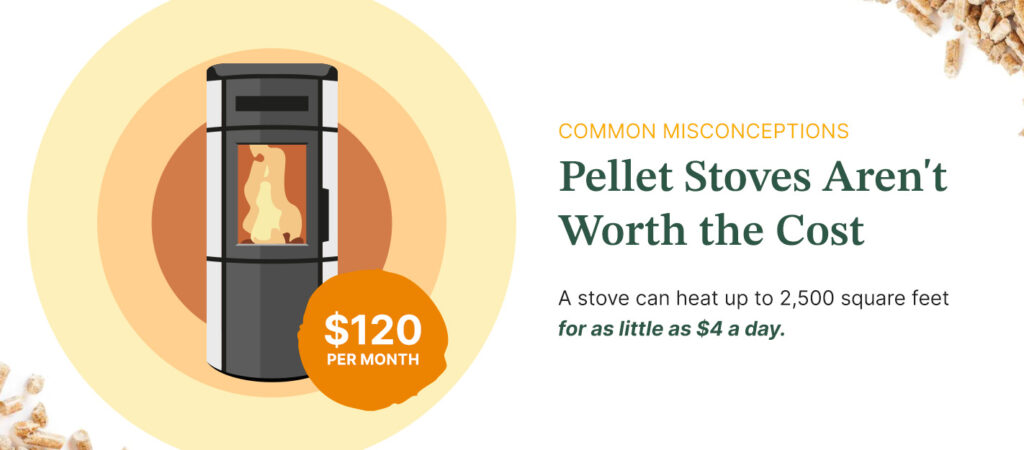
That efficiency shows up fast in daily costs — a stove can heat up to 2,500 square feet for as little as $4 a day in fuel costs or roughly $120 over a full month of winter heating. Wood pellets have also historically held more stable pricing than heating oil or propane, both of which swing with global market conditions well outside a homeowner's control.
A Michigan State University life cycle analysis backs this up, finding that wood pellet heating runs less expensive than propane or oil over the long term, and that gap can widen the longer you own the stove.
That kind of savings depends heavily on what you're actually burning. Pellets with excess ash leave more residue that requires frequent cleaning and can reduce burn efficiency, while low-moisture, high-heat-output pellets convert more of each pellet's energy into usable heat rather than wasted energy.
This misconception often stalls buyers who care deeply about their environmental footprint, but pellet stoves are among the cleaner, more renewable solid-fuel heating options on the market today. Wood pellets are made from organic materials like sawdust, wood shavings and other residuals that would otherwise go to waste rather than from freshly cut trees.
The Environmental Protection Agency (EPA) backs this up directly, since certified pellet stoves must meet strict particulate matter (PM) emission limits, placing them among the cleanest solid-fuel appliances available for home heating, whether the stove vents through a wall or an existing chimney.
Not all pellets perform the same way here, either. Low-ash pellets certified by the Pellet Fuels Institute (PFI) are known for burning cleaner and more efficiently, producing fewer emissions and less residue than lower-quality alternatives — which is exactly why pellet quality and environmental performance go hand in hand.
Once pellet heating starts making sense, the fuel matters just as much as the stove, since not every bag of pellets performs the same way. Consistency is what separates a stove that runs smoothly from one that needs constant troubleshooting.
PFI-certified, low-ash pellets made from virgin wood residuals are built to deliver steady, reliable heat load after load, and that kind of consistency comes from a commitment to excellence that starts with sourcing and carries through every bag.
Still have questions about pellet stoves or home heating? Check out our resources on choosing the right pellet stove or explore our resource library to build your knowledge and heat your home smarter.